
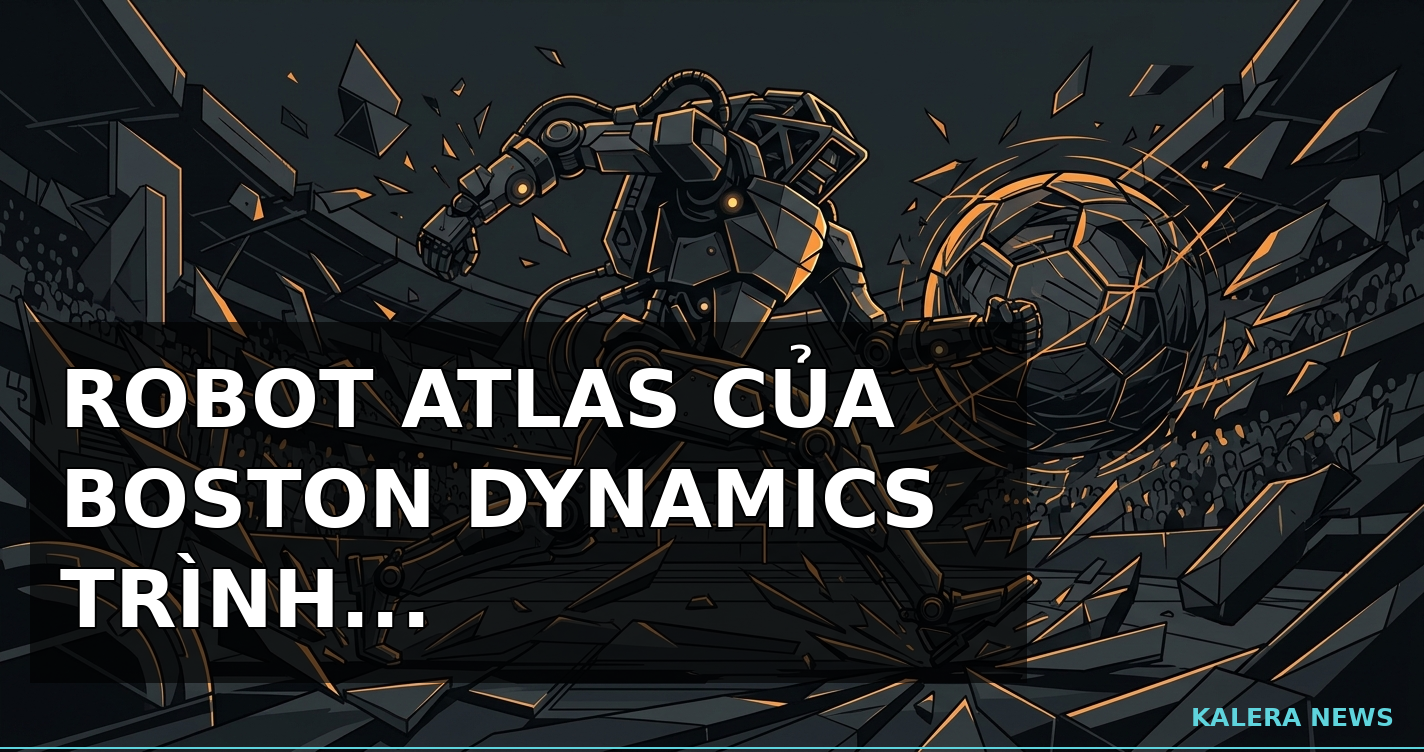
Boston Dynamics has officially shared behind-the-scenes insights into the live demonstration of its next-generation Atlas robot at the FIFA World Cup 2026. This event marks a significant milestone as one of the world's most advanced humanoid robots stepped out of the laboratory to perform in front of millions of live and broadcast viewers.
Detailed Developments
According to Seth Davis, Senior Program Manager at Boston Dynamics, Atlas' debut at the World Cup 2026 required extremely rigorous preparation. The engineering team faced massive challenges in ensuring the robot could operate stably on the natural grass of the stadium. A live football environment is chaotic and unpredictable, vastly different from the simulated indoor environments where the robot is typically tested.
Technical & Technology Analysis
To successfully navigate and interact on the pitch, the next-generation Atlas robot was upgraded significantly with an all-electric actuator system instead of the old hydraulic setup. According to Boston Dynamics, this transition makes the robot quieter, lighter, and capable of highly precise torque control. The depth-sensing camera systems and real-time computer vision algorithms were also optimized to help Atlas identify the ball, teammates, and fast-moving obstacles around it.
Expert Opinions & Insights
Seth Davis emphasized that bringing Atlas onto the pitch was not just a publicity stunt, but a rigorous real-world test of the robot's adaptability. Industry experts noted that the robot's ability to maintain balance and execute basic athletic maneuvers on soft, uneven grass is an incredible mechanical feat, proving that humanoid robots are moving closer to practical real-world applications.
Impact & Future
Atlas' successful demonstration at the World Cup 2026 opens up great prospects for deploying robots in search and rescue, public services, and large-scale entertainment. For the tech community, this event is clear proof that the era of practical assistive robots is not far away. Transitioning from laboratory environments to the planet's biggest sporting events demonstrates that hardware and AI control reliability have reached a new threshold of development.