
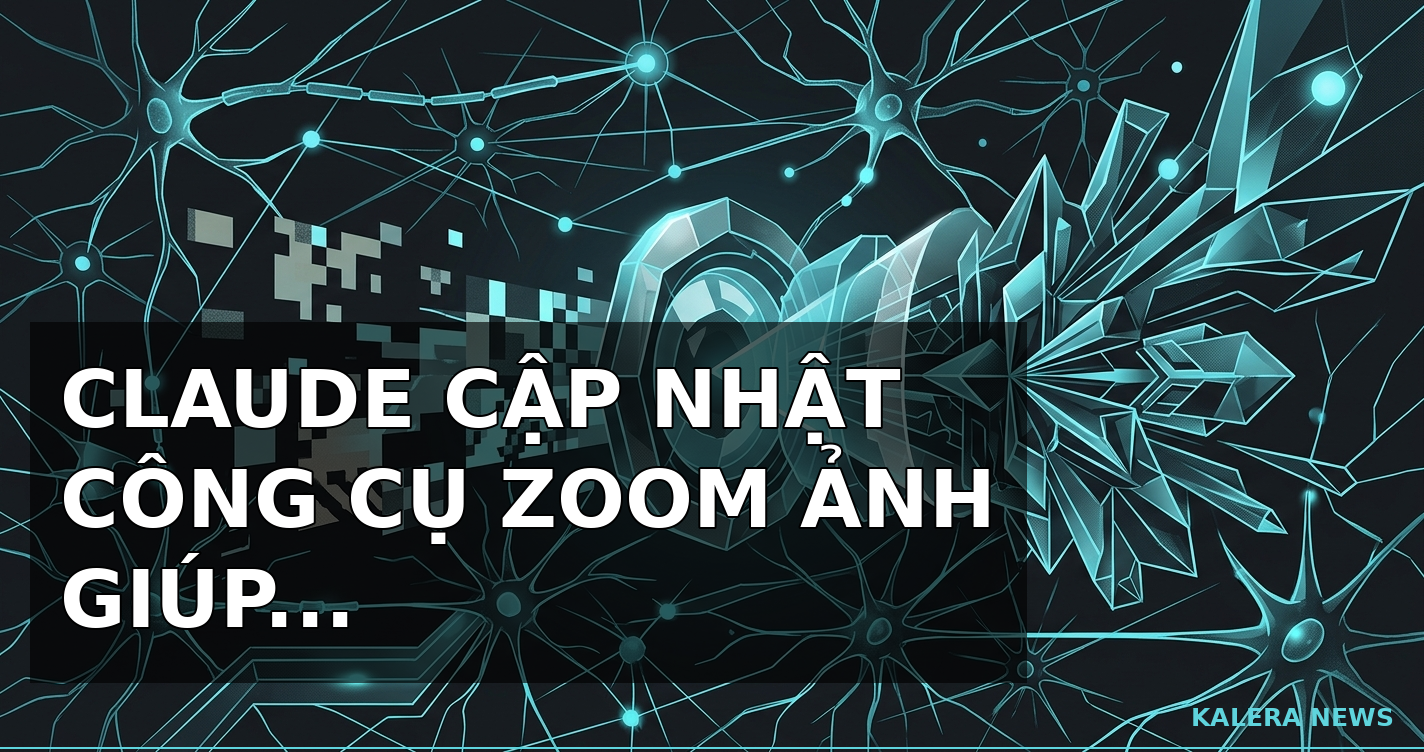
The Claude developer team (@ClaudeDevs) has announced an update to their "zoom tool" cookbook for next-generation large language models. This tool addresses a persistent bottleneck in computer vision: the loss of critical details when large images are automatically downscaled before being fed into a model.
Diễn biến chi tiết
According to the announcement on July 23, 2026, this new technical solution allows models like Claude to request a specific region from the original image and receive that crop back in its full original resolution. Instead of processing an entire massive image, which is computationally expensive, the model can now focus on small but decisive details.
The developer team has shared concrete source code and implementation guides in this updated cookbook. Thanks to this flexible mechanism, the technology promises to significantly enhance AI's capability to comprehend visual documents, expanding the current limits of multimodal data analysis.
Phân tích kỹ thuật & Công nghệ
Technically, processing large image files has always been a trade-off between computational cost and vision model accuracy. When feeding images into an LLM, the system typically downscales them to fit within the context window limits and neural network architecture, which inadvertently blurs small characters or fine lines.
By integrating the "zoom tool" as a function calling tool, Claude can automatically evaluate suspicious information regions and send a crop query. This process allows the model to obtain the exact original pixels of the target area without reloading the entire high-quality image into memory.
Ý kiến chuyên gia & Nhận định
Empirical tests conducted by the development team on the Chartography benchmark—a dataset of 100 questions based on dense, real-world charts—showed highly impressive results. Specifically, the accuracy of the Fable 5 model surged from 29% to 73% when equipped with this zoom tool. Meanwhile, the Sonnet 5 version also recorded a substantial improvement, rising from 13% to 44% accuracy. According to analysts, these numbers demonstrate that optimizing input data ingestion can sometimes yield far greater efficiency than merely scaling up model parameter sizes.
Tác động & Tương lai
This improvement opens up vast practical application potential for the AI developer community globally and in Vietnam, particularly in high-precision fields like financial report analysis, technical blueprint reading, or medical imaging. Users no longer need to worry about AI missing small notes or figures buried deep within complex tables. In the future, similar tools are expected to become a mandatory standard for multimodal AI systems, helping to bridge the gap between computer vision and human perception.