
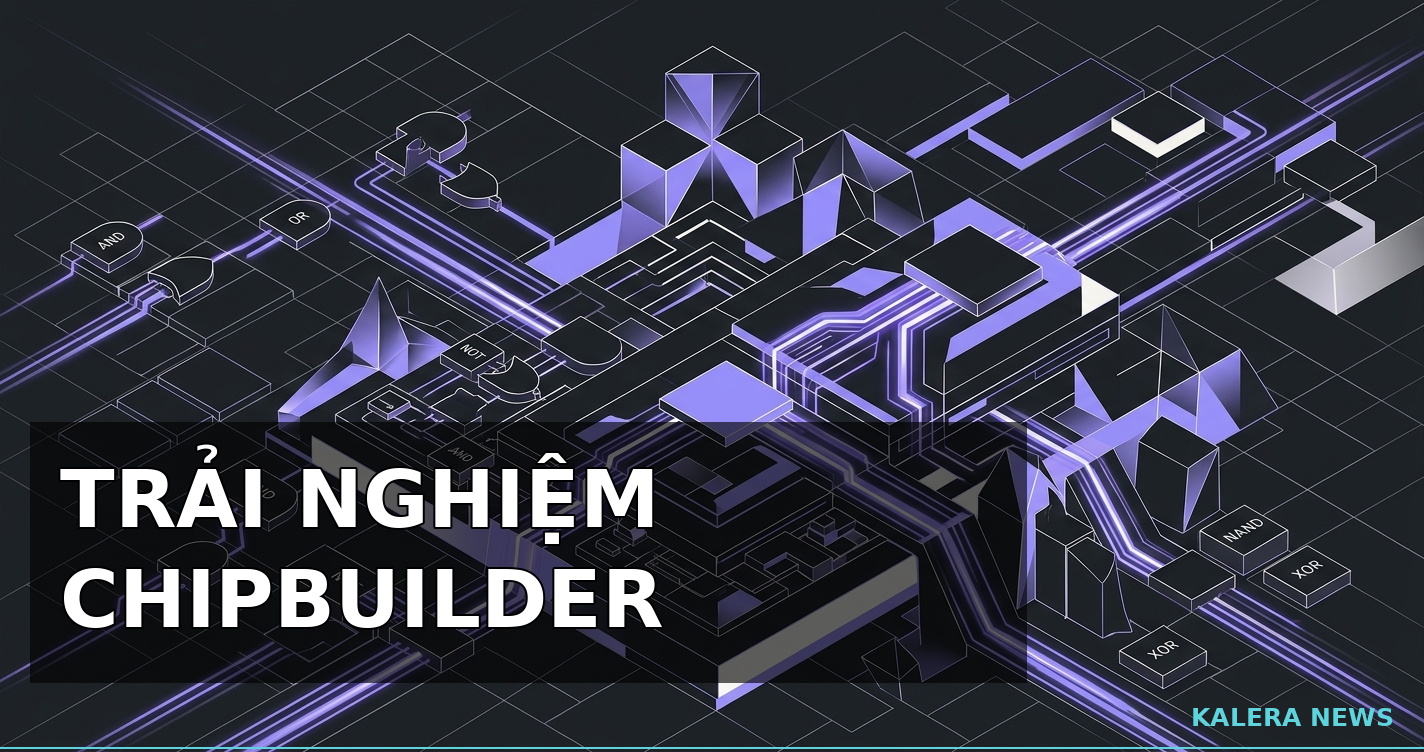
An independent developer recently launched and widely shared a game project called "ChipBuilder" on the Hacker News tech community on July 30, 2026. This unique browser-based game allows users to design and assemble a complete central processing unit (CPU) from the absolute ground up, using fundamental logic gates as building blocks. The project immediately captured the attention of software developers, systems engineers, and computer science enthusiasts globally, thanks to its highly interactive user interface and profound educational design.
Bối cảnh & Nguyên nhân
Learning traditional computer architecture has always been a significant hurdle for engineering students due to heavy theoretical loads and a lack of engaging, real-time simulation tools. Prior to ChipBuilder, well-known titles such as "Turing Complete" and "NAND Game" found success by pioneering the gamification of hardware design. The release of ChipBuilder continues to reinforce this trend, addressing the difficulty of accessing low-level logic by introducing an intuitive, drag-and-drop system designed specifically for software developers who are accustomed to working primarily with high-level software abstraction layers.
Phân tích kỹ thuật & Công nghệ
Technically, the game guides players through a structured logic learning path. Players begin by constructing basic gates like AND, OR, NOT, and XOR using only a single primitive logic gate, typically NAND or NOR. From these initial building blocks, the system challenges players to connect and optimize circuits into complex computational modules, such as Half Adders, Full Adders, Multiplexers, and ultimately, the Arithmetic Logic Unit (ALU)—the computational core of any CPU. The entire circuit simulation is optimized to run smoothly within a standard web browser using JavaScript and HTML5 Canvas, allowing users to perform real-time verification of truth tables for their custom circuit designs.
Ý kiến chuyên gia & Nhận định
On tech forums, ChipBuilder has received high praise for its minimalist interface, which eliminates clutter and lets players focus entirely on algorithmic thinking and gate optimization. However, from a professional perspective, some integrated circuit (IC) design engineers have offered constructive feedback. They point out that the game's logic simulation operates in an idealized environment, abstracting away real-world physical constraints such as propagation delay, voltage drops, and clock jitter. Despite these simplifications, experts broadly agree that ChipBuilder is an exceptional introductory tool for building digital circuit intuition before students move on to professional hardware description languages like Verilog or VHDL.
Tác động & Tương lai
Educational games like ChipBuilder are instrumental in bridging the gap between software development and hardware engineering, fostering a generation of full-stack engineers who understand everything from hardware layers to application levels. For the technology community and engineering students in Vietnam—especially as the domestic semiconductor industry is designated as a national strategic focus—these free, interactive tools offer immense educational value. The trend of merging entertainment with deep technical education (EdTech) is poised to accelerate, making semiconductor and microcircuit knowledge accessible to everyone in an equitable and engaging manner.