
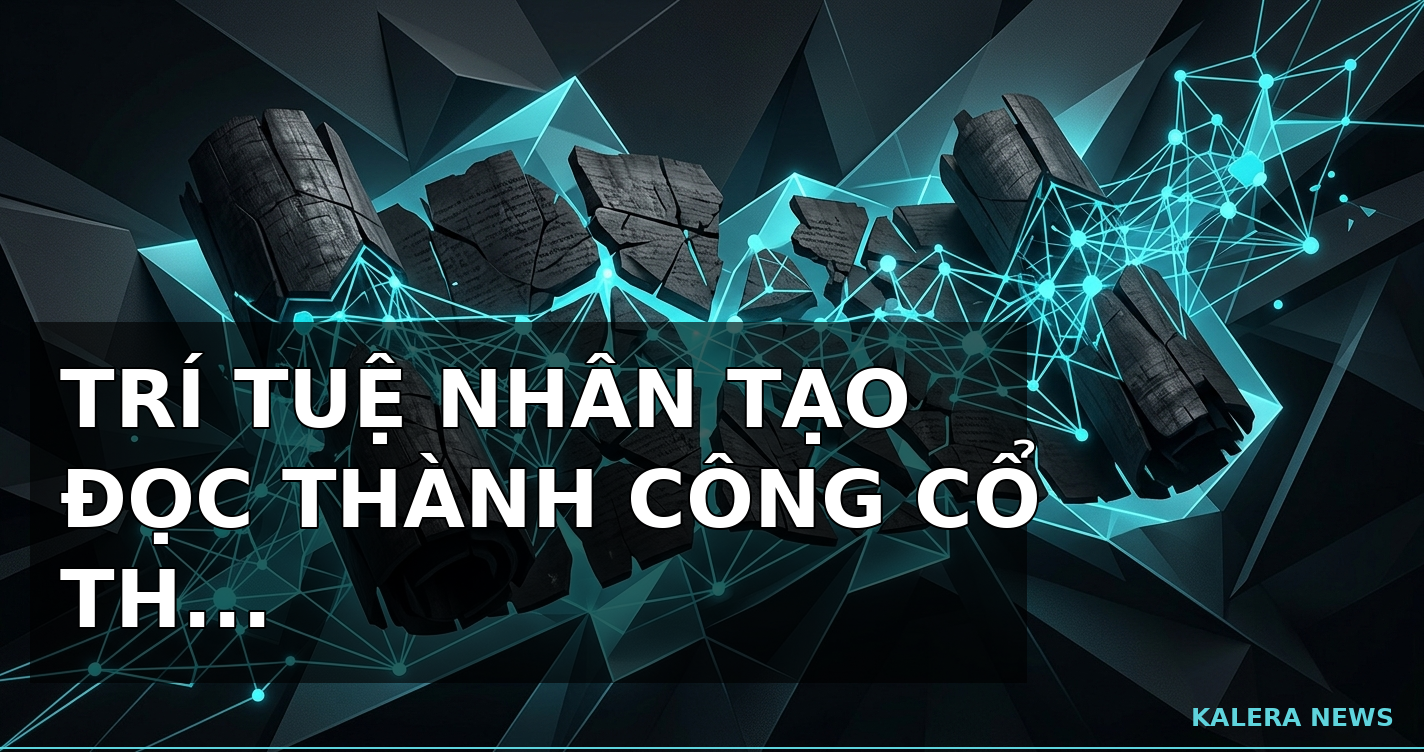
Researchers have successfully decoded a 2,000-year-old carbonized ancient scroll by combining high-resolution X-ray imaging and machine learning. This breakthrough opens up opportunities to read hundreds of historical documents once deemed impossible to recover. The first successfully decoded scroll has been identified as a work on Stoic philosophy.
Background & Context
The Herculaneum scrolls were buried in a Roman villa when Mount Vesuvius erupted in 79 AD. Over millennia, these documents became completely carbonized into hard lumps of charcoal. In the past, all physical attempts to unroll these scrolls failed, instantly crumbling the fragile layers. Seeking a breakthrough, a global competition named the 'Vesuvius Challenge' was launched in 2023, calling on the tech community to use AI to decode the ancient texts.
Technical Analysis & Technology
The new method takes a completely non-physical approach to preserve the artifact's original state. First, scientists perform ultra-high-resolution X-ray CT scans to create a detailed 3D model of the tightly rolled scroll. Then, machine learning algorithms are trained to detect extremely faint traces of ancient ink hidden deep within the carbonized fibers. The AI model successfully separated the overlapping image layers, clearly reconstructing the original text.
Expert Insights & Perspectives
According to researchers on the social media platform X, reading the first scroll is practical proof that AI can uncover historical moments buried for thousands of years. Archaeologists are extremely thrilled by this result. The success of the 'Vesuvius Challenge' has triggered a new technological race to decode hundreds of other archived ancient scrolls.
Impact & Future Outlook
This breakthrough not only helps reconstruct ancient philosophical works but also reshapes the approach to digital archaeology. For historical researchers, mastering this technology means opening the door to thousands of invaluable documents once considered lost forever. In the future, the combination of advanced machine learning algorithms and medical imaging diagnostics promises to bring more groundbreaking discoveries about ancient Roman civilization.