
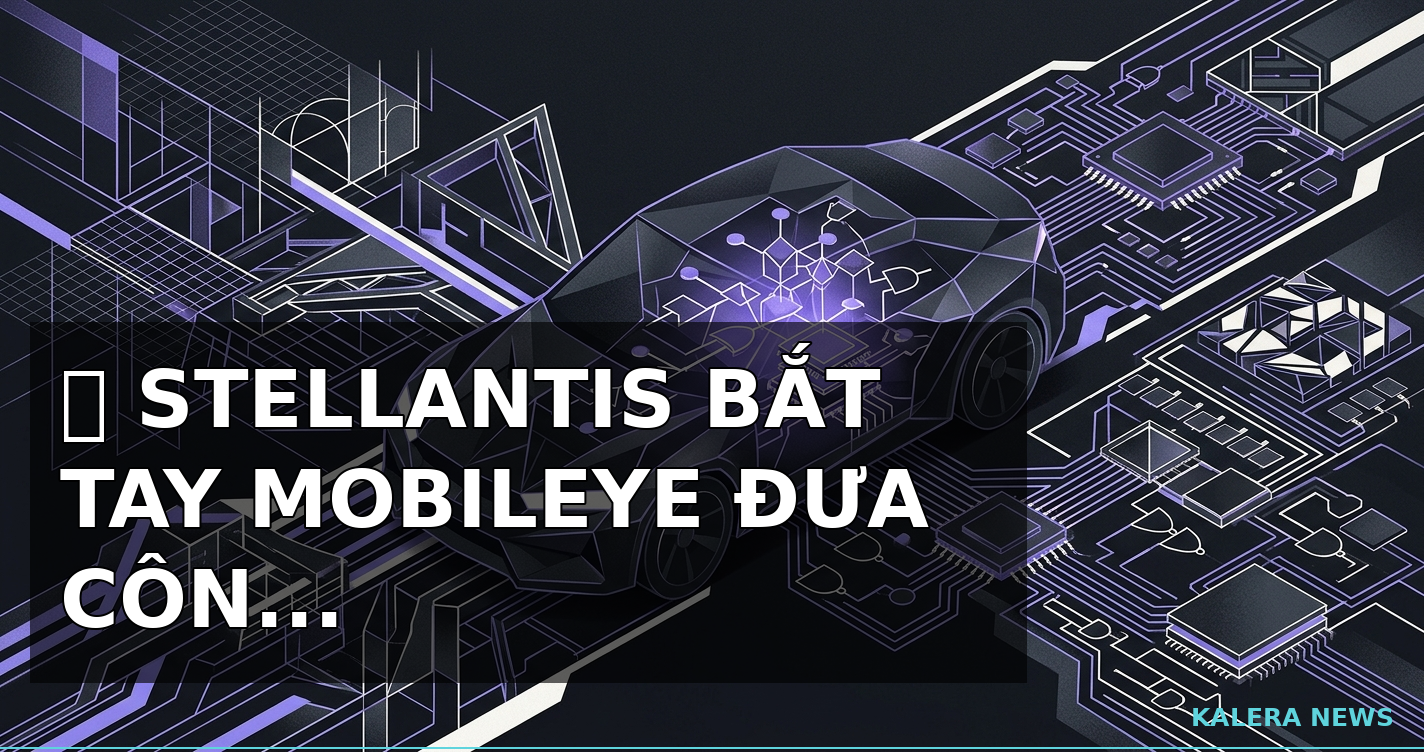
Multinational automotive corporation Stellantis has announced a strategic partnership with Mobileye, the Intel-owned autonomous driving technology company, to integrate Level 2 hands-free driving systems into its production vehicles. According to reports from The Verge, this collaborative project will officially begin commercial deployment on next-generation models starting in 2027. This is seen as a strategic move by Stellantis to catch up with competitors in the rapidly accelerating smart vehicle race.
Detailed Developments
The partnership agreement, announced by the two giants on Tuesday, reshapes Stellantis's autonomous driving roadmap. Starting in 2027, the automotive group—which owns prominent brands such as Jeep, Ram, Dodge, Chrysler, and Peugeot—will begin equipping Mobileye's hardware and software onto its new product portfolios. According to the plan, the integration will be executed in phases, prioritizing key markets before expanding globally. This partnership is expected to help Stellantis shorten research and development cycles and quickly bring to market vehicles capable of safe autonomous driving, competing directly with Tesla's Autopilot or General Motors' Super Cruise.
Technical & Technology Analysis
At the heart of this collaboration is Stellantis's use of Mobileye's high-performance EyeQ system-on-a-chip (SoC) family to handle the complex computational tasks required by automated driving systems. Additionally, Stellantis's next-generation models will integrate a crowdsourced digital mapping technology called Road Experience Management (REM). This REM system operates by collecting anonymous real-time data from millions of Mobileye-equipped vehicles on the road to continuously build and update high-definition maps (HD maps). The combination of powerful EyeQ processors and REM's real-time map database allows Level 2 vehicles to precisely locate themselves within lanes and make highly accurate situational decisions, even in poor weather conditions or when road markings are faded.
Expert Opinions & Insights
Industry analysts suggest that Stellantis's choice of Mobileye is a pragmatic and safe move. Instead of developing an autonomous driving system from scratch—which requires massive capital and faces significant regulatory hurdles—the group opted for a pre-packaged but proven solution from Mobileye. According to independent experts, Mobileye is currently one of the world's largest providers of ADAS (advanced driver-assistance systems) solutions, and partnering with them significantly reduces technical risks for Stellantis. However, some observers also warn that over-reliance on third-party hardware and mapping could make it difficult for Stellantis to differentiate its technology from competitors using the exact same Mobileye systems.
Impact & Future Outlook
The widespread adoption of Level 2 hands-free driving by Stellantis in 2027 will have a significant impact on the global automotive market, driving new safety standards for consumers. For tech and automotive enthusiasts in Vietnam, this development opens up opportunities to soon experience smart vehicles with advanced active safety features from Stellantis brands distributed locally. Although fully autonomous driving (Level 5) remains a distant future due to regulatory and technical infrastructure limitations, the mainstream adoption of Level 2 hands-free systems will serve as the most practical stepping stone to enhancing daily driving experiences and reducing traffic accidents in the coming decade.